An ecologist establishes the site’s baseline conditions and identifies opportunities to enhance biodiversity.
Every Biodiversity Net Gain (BNG) project follows its own path, but most reach a point where long-term stewardship needs to be secured. That’s where ProHort EcoShield comes in with the conservation covenant process.
By the time you speak with us, ecological surveys have often been completed, habitats designed and a Habitat Management and Monitoring Plan (HMMP) prepared. Our role is to independently review the proposed long-term management of the site and, where appropriate, enter into a conservation covenant that protects those habitats for the future.
Working alongside landowners, developers and ecological consultants, we help ensure the legal agreement reflects the ecological objectives of the project while providing clarity and confidence for everyone involved.
An ecologist establishes the site’s baseline conditions and identifies opportunities to enhance biodiversity.
A Habitat Management and Monitoring Plan (HMMP) is prepared, setting out how habitats will be created, managed and monitored over the required period.
We review the ecological and legal information, carry out due diligence and assess whether the proposed conservation covenant is suitable for the project.
Once both parties are satisfied, the conservation covenant process is completed, creating a legally binding agreement that secures the long-term management of the land.
The agreed habitat works are implemented in accordance with the approved management plan, helping biodiversity gains become established over time.
Throughout the covenant period, we remain involved by reviewing monitoring information, carrying out site visits where required and working collaboratively with landowners to support successful habitat management.
A conservation covenant is more than a legal document. It provides the framework for protecting and managing habitats over the long term, bringing together ecological objectives, land management responsibilities and legal commitments within a single agreement.
Once we’ve completed our review and are satisfied that the project is suitable, we begin preparing the conservation covenant. We work closely with all parties to ensure the agreement accurately reflects the approved Habitat Management and Monitoring Plan (HMMP), the characteristics of the site and the long-term objectives for biodiversity.
Our aim is to produce an agreement that is clear, proportionate and practical, giving everyone confidence in how the land will be managed throughout the covenant period.
Each conservation covenant is tailored to the individual site, but typically includes:
● The land covered by the agreement.
● The habitats being protected or enhanced.
● The conservation objectives for the site.
● The management and monitoring requirements.
● Roles and responsibilities of each party.
● Reporting arrangements and review periods.
● Provisions for the long-term stewardship of the land.
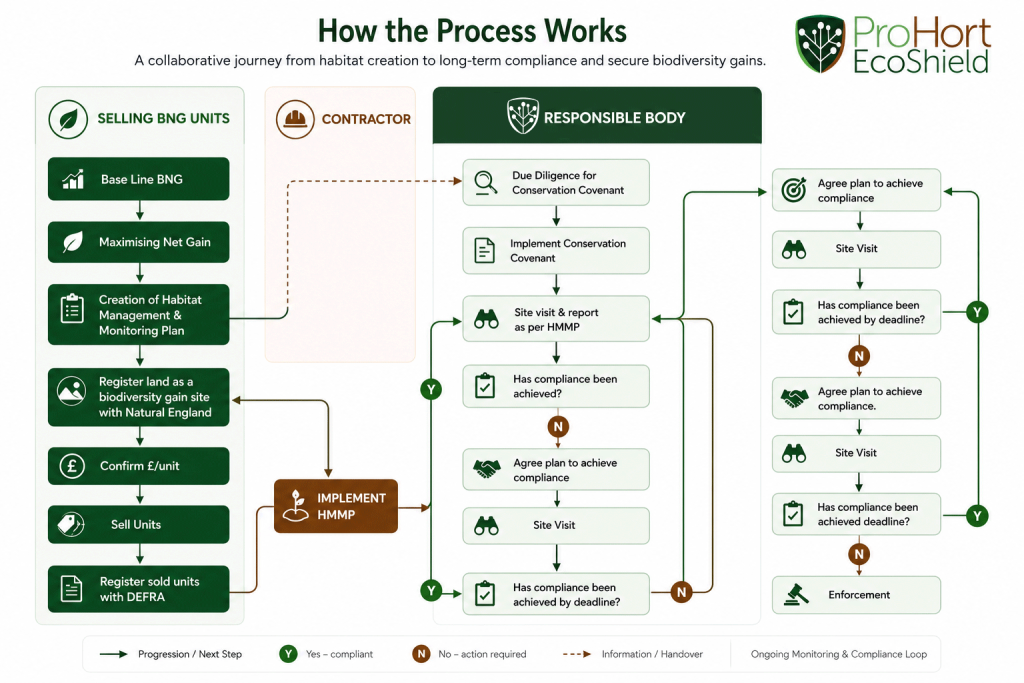
The diagram below provides an overview of how a conservation covenant progresses from habitat planning through to long-term stewardship and compliance.
Our role extends beyond signing a legal agreement in the conservation covenant process. We see ourselves as long-term partners in the success of your project.
Conservation covenants are designed to provide certainty, but they also recognise that landscapes evolve over time. Through regular communication and proportionate monitoring, we work with landowners to support the objectives of the Habitat Management and Monitoring Plan while helping projects remain practical, achievable and environmentally successful.
Whether you’re at the planning stage or ready to prepare an agreement, we’re here to help at every phase of the conservation covenant process.
A Responsible Body is typically appointed once the Habitat Management and Monitoring Plan (HMMP) has been prepared and there is sufficient ecological information to assess the long-term management of the site. Early discussions can help identify any outstanding requirements before a conservation covenant is drafted, making it easier to progress the agreement without unnecessary delays.
Notice that in the first sentence you’ve naturally introduced:
A conservation covenant is a voluntary legal agreement between a landowner and a designated Responsible Body. It secures the long-term management of land for conservation purposes and is commonly used to support Biodiversity Net Gain by protecting habitats for the agreed management period.
No. The most appropriate legal mechanism depends on how the Biodiversity Net Gain will be secured. Some projects use planning obligations, while others require a conservation covenant with a Responsible Body. The correct approach depends on the development, the land ownership and the planning authority’s requirements.
The information required will vary depending on the project, but typically includes the Habitat Management and Monitoring Plan (HMMP), Biodiversity Metric, ecological reports, site plans and details of land ownership. If additional information is needed, we’ll explain what’s required and why.
Once the agreement is completed, the long-term management of the site begins. Habitats are created or maintained in accordance with the approved Habitat Management and Monitoring Plan, while ProHort EcoShield undertakes monitoring and compliance reviews throughout the covenant period.
Our first priority is always to work collaboratively with landowners and project teams. If monitoring identifies that habitat management isn’t progressing as expected, we’ll discuss practical solutions, agree appropriate actions and provide a reasonable opportunity to achieve compliance before considering formal enforcement where necessary.